This is the first day of the
Tamil Calendar akin to the Western January 1st New Year. However,
according to the Western Calendar, Tamil New Year starts on April 14, spring
time.
Very few
dates of Hindu festivals happen on the same time every year, especially when
related to the Western Calendar. Tamil New Year always falls on April 14.
This is typically a Jain holiday.
However, Hindus also celebrate this day. The main ritual done on this day is to
buy new gold or silver jewels. It is considered auspicious to buy and wear new
jewelry on this day.
Rakhi, or
Raksha Bandhan is a festival that originated in North
India, but the younger generation celebrates this in Chennai.
Girls and Women pray for the welfare of their brothers during this festival.
They symbolically demonstrate this by tying a thread with or without trinkets
on it on their brother’s hand.The girl can tie the Rakhi on a blood brother, a cousin brother or a
close friend that is a male. If a boy has a Rakhi tied on him it means two
things, one is that he must protect the girl and, two, the girl is a sister to
him, and, due to that, should not think of marrying this girl. Hence, during
this time, guys try to avoid girls tying Rakhi on them at any cost. It is noted
that any one receiving a Rakhi returns the favor. Whoever tied the Rakhi on the
boy, must receive a ‘thank you gift’ from the boy. This can include
a small present or money.
Fall Navarathri usually falls a
day after the new moon in Puratasi month, which is September-October month in
the Western calendar.Nava means
nine and rathri means night, hence this festival lasts nine nights.
Day 1:
Dhanteras – Goddess Lakshmi is worshipped on this day. Dhan means wealth,
and one form of Lakshmi is Dhannalakshmi.Many businesses in India
use this day as their financial new year, or audit time. People decorate their
homes with plants, colorful kolums, floor designs, and burn oil lamps all day
and night.
Day 2:
Choti Diwali- On this day, Lord Krishna had killed an evil demon king. After
the battle, Krishna returned before sunrise to
bathe. He was given bath in scented oils.It is tradition on this day to have an oil bath on the entire body and
hair also.People prepared scented
oil from different oils. I was aware of using sesame oil and some additional
spices. After taking oil bath, one takes some shikakai or other herbal mixed
powders to rub the oil off. These powders soak up the oil and also exfoliate
the skin, leaving it with a healthy glow. People also elect to take a bath with
soap and water after this as well.
Day 3:
Lakshmi Puja
Day 4:
Padwa- This marks the coronation of King Vikramaditya
and Vikaram-Samvat. Hence Diwali, if treated as a new year, is called Vikram
New Year.
Day 5:
Bhayya Dhuj – This is the day that Brothers visit their sister’s
homes and sister’s pray for their brother’s welfare. It is also on
this day, brothers give their sisters gifts.
This
festival is widely known only in Tamil Nadu.It is the festival that ends the end of
the festival season. Karthigai is the name of the month, and deepam means
light. Though Diwali is known over India for being the festival of
lights, Karthigai Deepam is truly the Tamil festival of lights. Some begin
burning oil lamps throughout Diwali and until this festival.Temples
are full of small oil lamps; you must be careful where you step! The number of
oil lamps, sizes, shapes and smells of burning oils and butters is a fabulous
experience for your eyes and nose!Many burn oil in a five wicked deepam, each wick stands for elements of
a successful life- health, wealth, learning, courage and longevity.
This
festival is famous in the town of Thiruvanmallai
in Tamil Nadu. On this day, they ignite a flame that can be seen for 35
kilometers. This flame is powered by 1,000 kilos of ghee and 350 meters of
wicks in a cauldron ten feet high and five feet in diameter. During the night
devotees can climb the hill to offer ghee to this fire. As this fire is large
and extremely hot, the ghee is fed into the fire through a ten foot tube. Many
also note that walking around this hill is good for health as many medicinal
plants grow there. It is noted that as this festival falls near the winter
equinox, the days are very short at this time of year and the lit oil lamps
brighten up the night in a grand way.
The myth
or story behind this festival is that many years ago Vishnu and Brahma had an
unresolved conflict. At this time, they prayed to Lord Siva for an answer. Lord
Siva came to them as a column of fire, of which neither end could be
discovered. Hence, we pray to Lord Siva on this day as one of the five
elements, this one being fire.
Bhogi day falls on the last day
of Margazhi month. On this day, spring cleaning is done from top of the house
to bottom. In villages it is a grand scene. Those living in mud huts will clean
the outermost layer of mud off their walls and replace with mud and smeared cow
dung. It is said the cow dung has medicinal properties. And against most
belief, there is no adverse smell from this process.Also, the grounds in front of the home
are dug up and removed and resurfaced. Families like to purchase new implements
for their home, and on this day they are installed. For example, my friend’s
family I stayed with in the village installed a ceiling fan on this day.
Bhogi, and all Pongal festivals
fall on the same date in the Western calendar every year. These fall in the
tenth month of the Tamil calendar. Interestingly, Pongal is the equivalent of
American Thanksgiving, which also falls in the 10th month, November.
The three days of Pongal are a
grand sight in the villages of Tamil Nadu. Though city folk will celebrate
Pongal, it being a harvest festival, the real fun is in the village.
The 14th
day of the dark half of every month is called 'Sivaratri''. The one in the
month of Maasi (February-March) is known as 'Mahasivaratri'.Of all the major Hindu festivals,
Mahasivaratri is the only one that is more a serious affair. There is
practically no festivity, revelry or gaiety in its observance, the whole thing
being one of continuous solemnity.
This vrata or penance is open to all human beings. The basic disciplines to be
kept up on this day are ahimsa (non-injury), satya (speaking the truth),
Brahmacharya (continence), daya (compassion), Ksama (forgiveness) and anasuyata
(absence of jealousy).
On Mahasivarathri night all fast and stay up all night praying to Lord Siva. On
this night, it is considered auspicious to do abhishekham to Lord Siva. That
means bathing him with milk, honey, water, and nectars. Devotees stay up all
night and as they do abhishekham, they also sing bhajans, or religious songs,
chant mantras, and participate in homa, or fire worship.It is also said that on this night, Lord
Siva and his wife Parvathi ride around the earth on their bull, Nandi.If devotees continuously repeat a wish
of theirs, if Siva, Parvathi and Nandi hear it on their way by, they will grant
your wish. In fact, this is incorporated into some Siva rathri rituals as
devotees whisper a wish into the statue or murthi of Nandi.
For more on Sivarathri, visit this page in my site: Maha Sivaratri Experience: Lambodara Das- March 13, 2002
Ugadi is the New Year for the
Telugus, the people of Andhra Pradesh living to the north of Tamil Nadu.
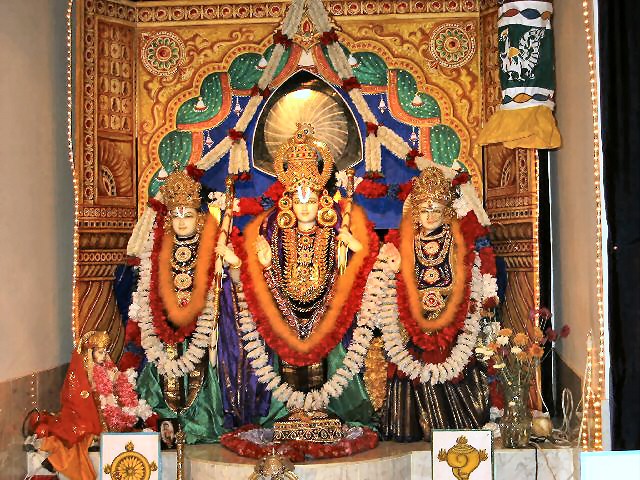
Spring Navaratri is the nine days
in the year dedicated to the goddess and welcoming in the spring weather. It is
also, again, during this time, Lord Rama is worshipped, as at the end of
Navaratri is Rama Navami, or Lord Rama’s birthday.It is during these nine nights devotes
of Lord Rama recite the Ramayana.
Ramanavami: 9 days after start of Spring Navarathri
Ramanavami is the birthday of
Lord Rama. Navami means the ninth night. This day is celebrated as the ninth
and last night of the spring Navarathri, the nine nights of spring.
Lord Rama is the beloved brother
of Lakshman and husband of Sita. On this day, devotees will read the Ramayana,
the epic story that depicts Lord Rama's life.On this day, people also sing bhajans to
Lord Rama and/or attend music festivals. During this time of year, people
prepare to perform or watch Tyagaraja compositions. Saint Tyagaraja was a South
Indian music virtuoso who was a devotee of Lord Rama, and his compositions are
revered during this time of year.
This page has been visited times since it's inception in August 2005. Updated Oct. 2006. Updated January 2008. Updated October 2008.